

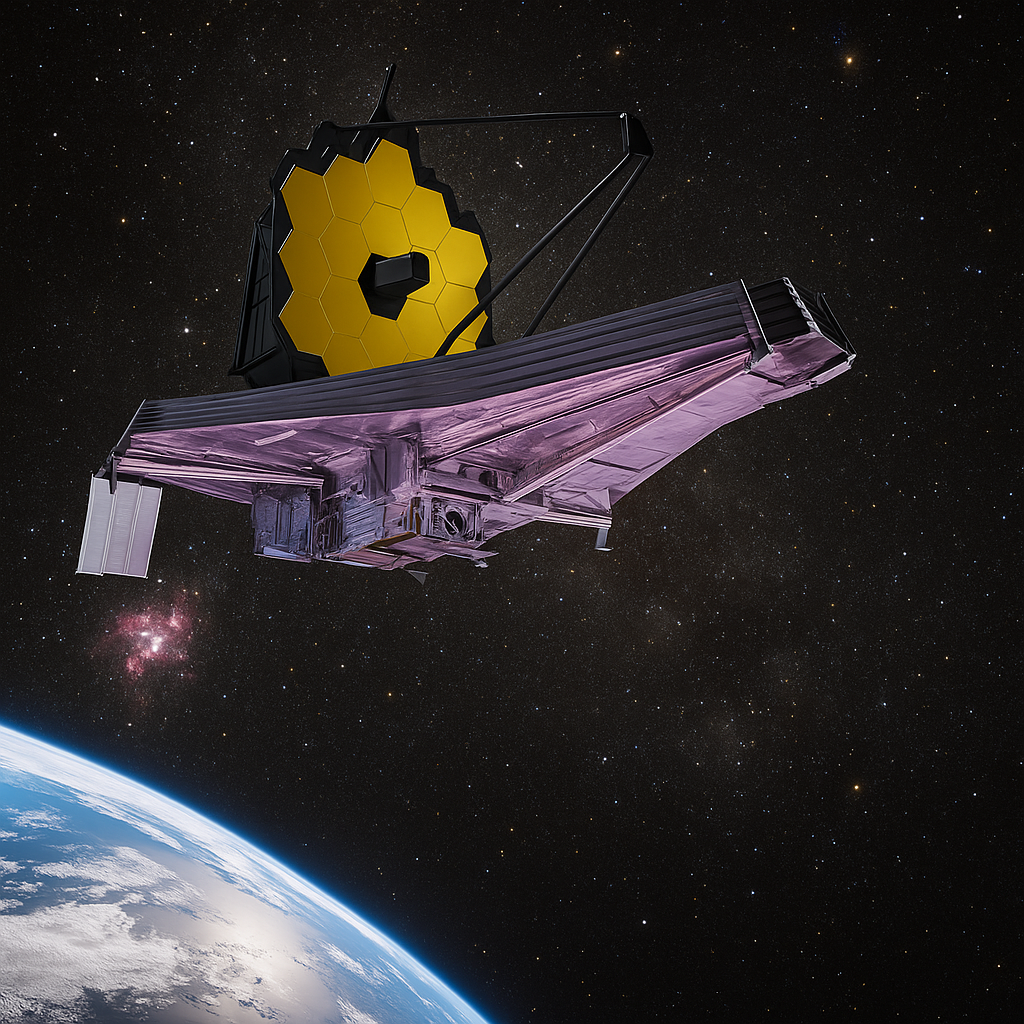
Hope Among the Stars: Possible Signs of Life Found on Distant Planet
In a quiet lab tucked within Cambridge University’s Institute of Astronomy, excitement is quietly building. A team of researchers, led by Professor Nikku Madhusudhan, may have found something extraordinary—clues that a distant world might be harboring life.
The planet, called K2-18b, orbits a star far beyond our solar system. And while it’s not the first time it’s caught the attention of scientists, this latest discovery—thanks to NASA’s James Webb Space Telescope—feels different. More hopeful. More alive.
Using JWST’s powerful instruments, the team detected unusual molecules in the planet’s atmosphere, including one that, on Earth, is only made by simple living organisms. It’s a subtle but potentially groundbreaking hint. A whisper from across the galaxy.
“This is the best sign so far that there might be life beyond Earth,” said Prof. Madhusudhan, his eyes filled with a cautious optimism. “We’re not there yet, but I truly believe we could confirm this signal in the next one or two years.”
This is the second time scientists have spotted life-linked chemicals on K2-18b, but this round of findings feels stronger—like we’re inching closer to an answer to one of humanity’s oldest questions: Are we alone?
Still, the team is careful not to jump to conclusions. Other astronomers agree—it’s a promising lead, but more data is needed. The universe doesn’t give up its secrets easily.
For now, the scientists wait, watching the stars, hoping that somewhere out there, life is waiting to be discovered.
A Whisper from the Cosmos: Are We on the Edge of Discovering Alien Life?
In the quiet corridors of Cambridge University’s Institute of Astronomy, something extraordinary is unfolding. A team of researchers, led by Professor Nikku Madhusudhan, believes they may have stumbled upon a clue—a faint but thrilling signal from deep space—that suggests life might not be unique to Earth.
The planet in question is K2-18b, a world over 700 trillion miles away, nestled in the orbit of a small red star. At about two and a half times the size of Earth, it’s far beyond our reach, at least for now. But that hasn’t stopped scientists from peering into its atmosphere with the incredible power of NASA’s James Webb Space Telescope (JWST).
This telescope, orbiting quietly above Earth, has been capturing the soft, filtered starlight as it passes through the gases surrounding K2-18b. And in that filtered glow, something remarkable has emerged.
The Cambridge team detected signs of dimethyl sulphide (DMS) and dimethyl disulphide (DMDS)—gases that, on Earth, are only produced by simple forms of life like marine phytoplankton and bacteria. The levels of gas observed were staggering—thousands of times more concentrated than what we find on Earth.
“I was honestly surprised,” said Prof. Madhusudhan. “To see that much gas in just one observation—it makes you wonder what’s really going on out there.”
But wonder alone isn’t enough. In science, especially when the question is as profound as “Are we alone?”, evidence must rise above all doubt. That means pushing past what’s known as a three sigma result—a 99.7% likelihood that the data is real—to a five sigma certainty. That’s 99.99999%—a standard so high it’s only used for the most groundbreaking of discoveries.
“We’re not there yet,” Prof. Madhusudhan admitted. “But I believe in a year or two, we could get that level of confidence. And if we do—it would mean that life might be common across the galaxy.”
His words carry weight. They also carry hope.
Still, not everyone is ready to celebrate. Astronomers across the globe are excited but cautious. Prof. Catherine Heymans, Scotland’s Astronomer Royal, is among those urging restraint. “Even with perfect data, we can’t be entirely sure these gases come from biology. The universe is strange. We have to be open to non-living explanations too.”
Indeed, some scientists suggest that the gas might be produced by exotic geological or chemical processes unknown to us. Others question whether the planet even has a surface—Dr. Nicolas Wogan from NASA suggests it could be a mini gas giant, with no solid ground to stand on.
But that’s the nature of discovery. It isn’t a straight line—it’s a maze of questions, tests, debates, and breakthroughs.
“This is not a moment of certainty,” said BBC’s Sky at Night host Prof. Chris Lintott. “It’s part of a much bigger journey to understand what’s out there.”
And yet, there’s something undeniably special about this moment. The scent of possibility hangs thick in the air. The kind of possibility that makes people look up at the stars and wonder if someone—or something—is looking back.
“Decades from now,” said Prof. Madhusudhan, “we may look back at this moment and realize this is when it all changed. When the idea of a living universe stopped being science fiction, and started becoming science.”
So, for now, the scientists keep working. The telescope keeps watching. And we—curious, hopeful, human—keep waiting. Because maybe, just maybe, we’re not alone.